February 11, 2023

Custom T-shirts Now Available


For those of us living outside of the UK or US, purchasing custom t-shirts from websites like Etsy and Redbubble can be an expensive endeavour. To circumvent costly shipping charges, I design and print my own t-shirts.


A variety of designs can be found by clicking on the Custom T-shirt tab, with more designs being uploaded in the very near future.

January 07, 2023

Indiana Jones And The Dunn & Duffy Circus Train


The opening scene of Indiana Jones and the Last Crusade is rife with callbacks and foreshadowing (what the cool kids these days call 'Easter eggs'). We witness the origin of Indiana Jones' iconic wardrobe; a wardrobe that he will, for the most part, remain faithful to for the next 60+ years of his life. Spoiler alert - the felt fedora was inexplicably gifted to him by a sweaty stranger. We find out how Indy got Harrison Ford's chin scar (freak whipping accident). But the sequence that is most meta is River Phoenix's chase along the length of the Dunn & Duffy circus train.


There are four distinct set pieces on the train:

  • The first, and most obvious callback, is the House of Reptiles carriage. It is reminiscent of the Well of the Souls in Raiders of the Lost Ark, and is responsible for Indy's totally justified fear of snakes.


  • Indy tussles with a whooping street tough on top of the next carriage, which houses a raging rhino. The rhinoceros horn protruding through the roof of the carriage and almost skewering our hero brings to mind the spike chamber in Indiana Jones Part Deux - The Temple of Doom.


  • The Last Crusade's Nazi book burning parade is foreshadowed in the next carriage, the Den of Lions. Later in the film, Indy's dad will convince him to retrieve the grail diary by going to Berlin, 'into the lion's den'.


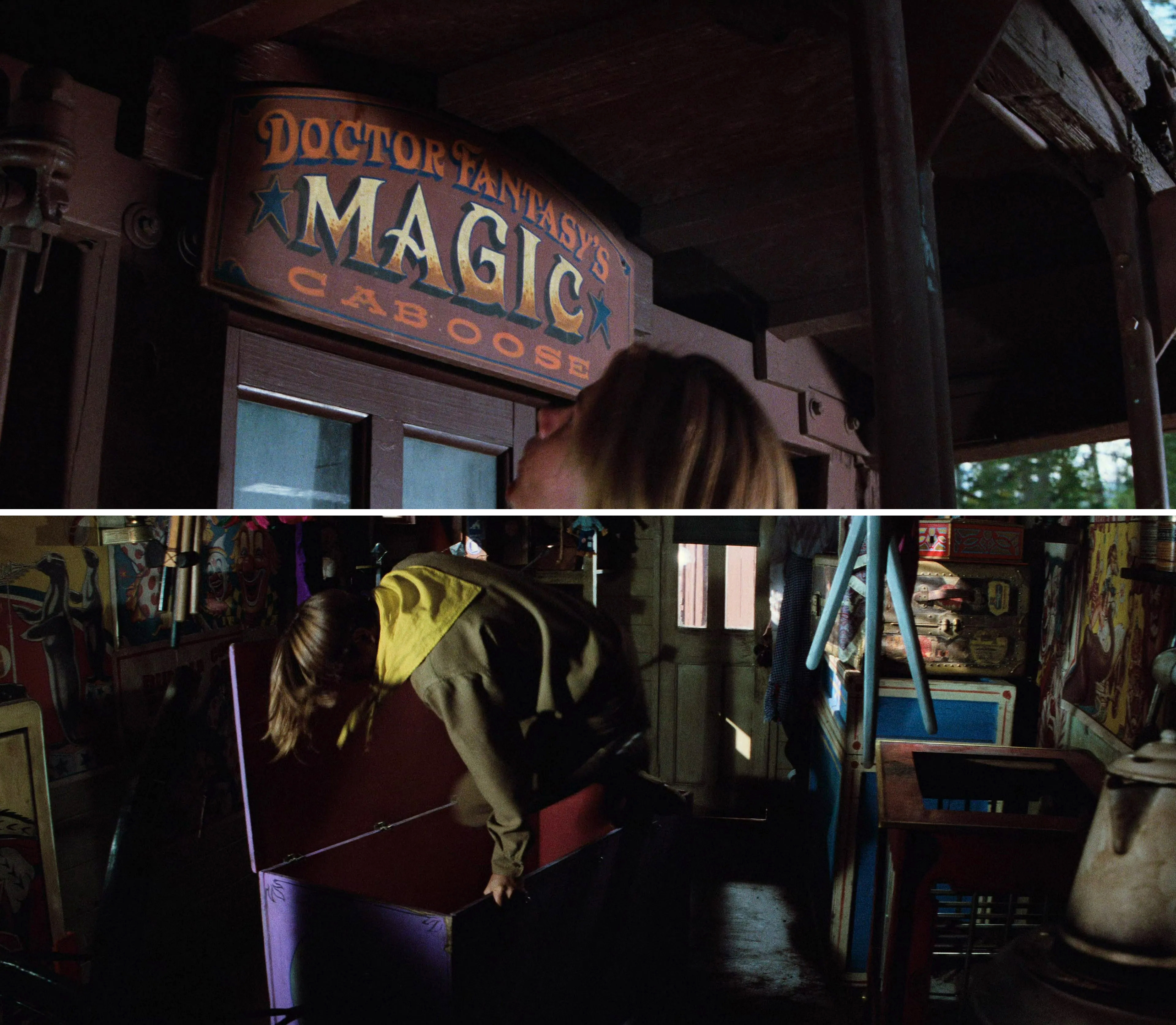
  • And finally, we get an inkling of the sorry state of Indiana Jones' fourth film adventure, upon entering Doctor Fantasy's Magic Caboose. In Kingdom of the Crystal Skull, Indy meets inter-dimensional, magical super beings. He also hides inside a fridge to avoid being disintegrated by an atomic blast, which is a bit like how he hid in a box to escape Doctor Fantasy's Magic Caboose.
 

January 06, 2023

M*A*S*H ft Something For Kate


M*A*S*H followed the exploits of the staff and patients at a Mobile Army Surgical Hospital during the Korean War. It was broadcast from 1972 to 1983, then continued in syndication for decades. Throughout my youth, M*A*S*H was one of a handful of shows that my entire family would gather to watch - mostly due to it being the only thing on at 7pm that was worth watching. This newspaper from 1984 can attest to that fact...


Something For Kate are an Australian alternative rock trio. Acclaimed by critics and fans alike, they have continued to release relevant and exceptional music for almost thirty years.

What does a thinly veiled anti-Vietnam War sitcom and one of the greatest Australian bands of all time have in common? Very little, unsurprisingly, except for the striking resemblance between singer Paul Dempsey and M*A*S*H's charismatic lead, Hawkeye (Alan Alda). The realisation of this got me thinking - What if the band shot a music video as if it were an episode of M*A*S*H, kind of like Weezer's 'Buddy Holly'? Instead of inserting the band members into actual footage from the show (as Weezer did with Happy Days), they could play characters from M*A*S*H. Bassist Stephanie Ashworth could be Margaret 'Hot Lips' Houlihan, and bearded drummer Clint Hyndman would play moustachioed surgeon B.J. Hunnicutt.


Back in 2005, I pitched the idea to Something For Kate. Needless to say, I never received a response. Now, almost 20 years later, I still feel it was a missed opportunity and, as a fan, would have gotten a kick out of seeing Paul Dempsey in a Hawkeye Pierce Hawaiian shirt and cowboy hat ensemble. So, for your reading pleasure, here is my original script for a Something For Kate/M*A*S*H music video...

January 03, 2023

View-Master Mock-Up: Let it Be

Since the release of The Beatles: Get Back, there has been a renewed interest in the original version of their 1970 documentary, Let It Be. However, copies of the film have been hard to come by, and as yet, it is unavailable on any streaming service. If only this View-Master set were real, we'd at least have 21 stereoscopic images of the band to gawp at.


December 22, 2022

Memories of Milk Bars


The Aussie milk bar was, in its heyday, as ubiquitous in suburban Melbourne as pubs are in the UK. Conveniently situated within walking distance of your home, they provided families with the essentials - milk, bread, newspapers, cigarettes. They were also purveyors of the 20 cent bag of mixed lollies, wax paper wrapped trading cards with pink concrete sticks of nostalgia fuel, and a wide variety of ice-creams and icy poles - Sunnyboys, Two-In-Ones, Eskimo Pies, etc. For a brief period, some milk bars even attempted to cash in on the home video bandwagon; however, based on the amount of sun bleached clamshell tape covers collecting dust in the spinner racks, very few people actually rented them.


On a recent trip back to Melbourne I found myself searching for the milk bars of my youth; in some sad way hoping I could walk in and find cartons of Return of the Jedi trading cards on the counter, a freezer full of Buck Rogers and Flash Gordon icy poles, or flyers advertising the double features playing at the drive-in. Of course, most of the milk bars are now gone, superseded in the nineties by the big chain supermarkets.

To alleviate this nostalgia, I spent the better part of this week creating a milk bar illustration from several reference photographs, and populated it with paraphernalia and advertisements from the late 70s/early 80s - from overtly sexual depictions of meat and vegetables deep fried into pastry tubes, to ill-conceived and unfortunately branded children's confectionery. Despite its anachronisms, I find the images of Panini sticker albums and defunct newspaper logos strangely compelling. Maybe you will too. And yes, that is a daybill for Alby Mangels' World Safari II: The Final Adventure.


October 04, 2022

The FAQ of Mad Max Beyond Thunderdome


Mad Max Beyond Thunderdome, Mel Gibson's third (and final) adventure in the wastelands of the Australian outback, is widely regarded as the weakest film in the franchise. Many supporters of this sentiment claim that Thuderdome's tribe of children, cartoonish violence and M rating were detrimental to The Road Warrior's R rated legacy. The plot itself might also be responsible for alienating its audience, with its holes and questionable logic. To assuage your confusion and increase your enjoyment of the film, I have compiled a list of Frequently Asked Questions about Mad Max Beyond Thunderdome, and trawled through Joan D. Vinge's novelisation to answer them in the time honoured format of the 'trading card'.

December 24, 2021

The Top 5 Similarities Between Paul McCartney and Paul Atreides


Frank Herbert’s science fiction novel Dune was released in August 1965,  almost 18 months after Beatlemania had reached American shores. Was Dune’s Paul Atreides modelled on Paul McCartney who, by that time, was more famous and revered than any other celebrity in the history of popular culture? Let’s investigate.


It’s fair to assume that Frank Herbert wasn’t in any way influenced by Paul McCartney when he began writing Dune in 1959. However, by 1965, he definitely would have been aware of the Beatles and the adulation heaped upon McCartney. Did Paul McCartney’s fame retroactively have an impact on Herbert’s characterisation of Paul Atreides, the oval faced, black haired teenage son of Duke Leto and the potential messiah of Arrakis? Am I once again finding parallels where there are none? Most likely. But here they are anyway, the Top 5 Similarities Between The Beatles’ Paul McCartney and Dune’s Paul Atreides:


Number 5: Dedicated Follower of Fashion

Both Pauls frequently dressed in militaristic garb, which had become particularly fashionable in London during the mid 60s. The Beatles famously wore military style jackets at their 1965 US performance in Shea Stadium (which, admittedly, was broadcast in the US two years after Dune was published).


Number 4: She Loves You (Yeah, Yeah, Yeah)

From 1963 until 1968, McCartney was in a relationship with actress Jane Asher. Paul Atreides' partner and concubine is Fremen warrior Chani Kynes. Despite the fact that her character is played in both film adaptations by brunettes, in the novel she is described as having red hair. Just like Jane Asher.


Number 3: You Know My Name

Paul McCartney shares his first name with Paul Atreides. In 1959, the name Paul was the 17th most popular name for boys. It remained relatively steady at that position through to Dune’s publication six years later. Although it stands to reason that an author might choose a popular name for his protagonist, let’s look at the names of some of the other male characters in Dune - Leto, Duncan, Gurney, Thufir, Wellington, Glossu, Fenring. Unlike Paul, each of these names sound sufficiently science fictiony for a novel set in the year 10,191. Unsurprisingly, all are absent from the top 100 list of boy names from 1959.


Number 2: Day Tripper

Both Pauls dabbled in hallucinogens. The spice melange of Arrakis bestows vitality,  longevity and prescience on Atreides, while the Beatles’ experiences with LSD opened their minds to new ways of creating music and cultivating facial hair. McCartney didn’t drop acid until late 1965, but LSD was readily available and partaken by artists, writers and musicians throughout the 60s.


Number 1: The Word

By modulating tone and pitch, both Pauls were able to use their voice to affect the lives of others. McCartney won the hearts and minds of teens and their mums the world over with his singing, while Atreides used the Bene Gesserit power of the Voice to literally control people’s thoughts and actions.

June 13, 2021

Book vs Film: Fight Club


Chuck Palahniuk’s Fight Club is a fast 208 page read and perfect fodder for the ‘hero’s journey’ narrative structure preferred by Hollywood producers and the general film consuming public. Despite Palahniuk’s unorthodox prose, it was, for the most part, faithfully adapted by Jim Uhls for David Fincher’s 1999 film. As with any novel to film adaptation, there were a number of notable differences between page and screen. This includes a subtle shift in its overall tone; the novel’s nihilism is substituted for the audience friendly optimism of the film. During the final act, Project Mayhem’s ultimate goal changes from being purely selfish - erasing the past (destroying a museum), to being selfless and altruistic - erasing debt (destroying credit card companies). The protagonist was successful in achieving this goal in the film, and did so in one of the most iconic movie climaxes of all time. The novel, however, ended with Tyler’s bomb failing to detonate and the narrator committed to a mental institution.

In the film, a messiah. In the novel, a
murdering psychopath.


Most of the changes made by Uhls and Fincher were justified, successful, and the reason for Fight Club’s ongoing notoriety more than 20 years after its release. Others, not so much. In keeping with Repeat Viewing’s purpose statement of pointlessly dissecting popular culture for the benefit of no-one, here is the best and worst of David Fincher’s Fight Club adaptation.

September 28, 2020

The Private Pyle Conundrum


Stanley Kubrick had many obsessions throughout his life and career. He loved a good notebook. He adored animals, particularly cats. And he had a big old man crush on Napoleon Bonaparte. There was however, one nagging problem when it came to the exiled emperor of 19th century France. Kubrick could not understand how a master strategist like Napoleon could be such a noob when it came to invading Russia. No army had ever managed to successfully invade Russia in 600 years, so why did Napoleon attempt it during the winter of 1812, when his soldiers were already pushed to their limits and dangerously low on supplies? This was a frequent source of confusion and frustration for Kubrick. I have a similar issue with Kubrick and his writing of Private Pyle’s character arc in Full Metal Jacket.


As big a fan as I am of Stanley Kubrick, even I can admit that his films are peppered with cringe worthy moments. Eyes Wide Shut, for instance, is full of them. Yet most of these directorial decisions are related to his penchant for ‘interesting’ performances. Private Pyle’s character arc stands alone in Kubrick’s filmography as, potentially, his one and only screenplay flaw. Spoilers ahead.

Private Leonard Lawrence enters Full Metal Jacket as a slack jawed mouth breathing dullard. His amusement at being berated by Drill Instructor Gunnery Sergeant Hartman earns him the moniker ‘Gomer Pyle’ and the first of many beatings. He is unfit, slow to learn, disliked by his peers and routinely humiliated. Then, under the tutelage of Private Joker, Pyle transforms into a well trained killing machine. He gains the respect of Hartman and graduates as a United States Marine Corps Infantry Rifleman.


Immediately following this, he is found sitting in the latrine with his rifle Charlene. He claims he is ‘in a world of shit’, and proceeds to murder Hartman before blowing his own head off. This is something I could never understand, and is the first of two points I would like to make on the subject. Pyle has achieved the impossible - he has become a Marine. So why is he still ‘in a world of shit’? Fair enough to say that he was in a world of shit, but now? Why not kill Hartman weeks ago? Why not blow your head off when you’re at your absolute lowest? Why wait until you’ve achieved the one thing no one said you could do before killing yourself? Other than to cap off the Parris Island segment with a shocking climax, what logical reason is there to place this scene here?


My second point is this - assuming Pyle wasn't drafted, why didn’t he just quit? Hartman hounded him relentlessly to leave, and it seemed to be an option, so why stick it out? I can see only two reasons why someone might choose to continue training despite the torture and abuse Pyle received:
  1. He had been given a court order stating that he either go to prison or join the Marines, and Pyle believed the alternative was worse.
  2. He needed the money. Perhaps Pyle was the sole income earner for his family, and maybe the Marines was the only employer willing to give him a job?

Now I am aware that none of the characters in Full Metal Jacket have fleshed out backstories, and that this was a conscious decision on Kubrick’s part. But if the audience is to believe that a character’s derangement was inevitable and unavoidable, then one or two lines about his criminal past or his destitute family might have sold that point more convincingly.

Kubrick’s screenplays evolve over years of countless writers, drafts and meetings. During filming, he rewrites scenes himself, over and over again with no concern for time or budgetary constraints. Every single story decision and line of dialogue is considered numerous ways before being immortalised on film. Private Pyle’s unconvincing character arc therefore, like Napoleon’s decision to push forward into a Russian winter, will forever remain a mystery for the ages.

June 19, 2020

The Parallelism of Kubrick and Kate


Stanley Kubrick and Kate Bush are two of the most important and influential artists of the 20th Century. Despite this, Kubrick is not renowned for his singing or dancing. Similarly, having recently laboured through Bush’s 1993 self proclaimed ‘load of bollocks’, The Line, The Cross and the Curve, it’s safe to say that she is not synonymous with film making. Yet both of these artists have so much in common it’s astonishing that everyone isn’t talking about it, like, all of the time. According to comedian Michelle Wolf, ‘Blogs are a conversation that no one wanted to have with you’. That observation has never been more applicable than to this red hot topic.

January 27, 2020

How To Make A Belated Sequel


It has become common practice for filmmakers to strip-mine the past for pre-existing IP with a ready made fan base. This has resulted in a slew of new 'first' sequels to movies from the 80s and 90s – movies that we never thought required a second outing. In 2020, sequels that may or may not be coming your way include:

I love a good dot-point list, so here's another one of belated releases from the past few years:

The fear of alienating those who are unfamiliar with the original has also precipitated the rise of the ‘soft reboot’ - films that are more remake than sequel. These films rarely adhere to a numbering system (for example, Rocky II, Rocky III, Rocky IV) but instead try to hide their numerical position in a larger franchise (Rocky Balboa, Creed). Every so often, though, a belated sequel will appear that proudly flaunts its sequelness. But does that always make for compelling viewing? Let's compare two recent examples...

October 01, 2019

Eyes Wide Shut: Masterpiece Or Meh?


I’m rarely confounded by a film, yet Stanley Kubrick's Eyes Wide Shut confounds me. In the twenty years since its release, I’ve watched it a thousand times; not because I like it, but because I still don’t know if I like it. Is it a work of genius, the culmination of a lifetime of obsessive research by history’s greatest film-maker? Is it a rumination on the masks we wear, itself masquerading its meaning behind layers and layers of inscrutable detail? Or is it the last ditch effort of a pervey old man to stare at some boobs? 

We've heard it all before: Eyes Wide Shut set the Guinness World Record for the longest film shoot of all time. Stanley Kubrick required his actors to perform take after take of inconsequential actions, so much so that Harvey Keitel quit and Tom Cruise developed a stomach ulcer.* Kubrick literally worked himself to death, suffering a major heart attack only days after completing his final cut of the film. Considering the time, money and energy that went into the making of Eyes Wide Shut, it's impossible to watch the film without regularly pondering the following question: What the hell is going on?

Other questions might include:
- How come no-one in this film seems to know how to act? 
- Why does New York City look so fake?
- Is the orgy supposed to be erotic, suspenseful or lame?


Let’s discuss.

July 23, 2019

E.T. The Extra-Terrestrial: A Novelisation To Film Comparison


Ancient, grotesque space monster falls in love with horny, suburban divorcee; not the kind of children's story you'd expect to become one of the most beloved and highest grossing movies of all time. Yet this is exactly the premise of William Kotzwinkle’s 1982 novelisation of E.T. The Extra-Terrestrial.

April 19, 2019

View-Master Mock-Up: Empire Of The Sun


1987 was a banner year for movies. It's easy to overlook the impact that this year had on popular culture and the film industry, especially when years like 1985 and 1994 continue to hog the metaphorical limelight. But take a look at some of the watershed moments on 1987's CV. In no specific order:

  • Predator
  • The Lost Boys
  • Robocop
  • Lethal Weapon
  • Full Metal Jacket
  • The Untouchables
  • Raising Arizona
  • The Princess Bride
  • Wall Street
  • Good Morning Vietnam
  • Evil Dead II

And also, these:

  • Can't Buy Me Love
  • Mannequin
  • The Running Man
  • Dirty Dancing
  • Spaceballs
  • Near Dark
  • Project X
  • Some Kind of Wonderful

The list goes on and on. One particular favourite of mine is Steven Spielberg's adaptation of JG Ballard's Empire of the Sun. Check out my comparison between the novel and the film here. Or just take a quick look at this imaginary Empire of the Sun View-Master reel set that I spent far too much time designing over the past week.


More merchandise for films that never existed can be found by clicking the CUSTOM TRADING CARDS, CUSTOM READ-ALONG RECORDS and CUSTOM VIEW-MASTER tabs at the top of the page.

April 06, 2019

View-Master Mock-Up: True Romance


Let’s take a peek inside the addled mind of Clarence Worley! When he’s not imagining the late Elvis Presley is his spirit guide and greatest fan, he’s fantasising about falling in love. Spoilers ahead for Tony Scott's 1993 film, True Romance.


On the night of his birthday, Clarence fails to find a date for the Sonny Chiba Streetfighter triple feature. Alone and despondent, he spirals into a fugue state; one in which he imagines himself to be a fast talking, highly capable cold blooded killer and drug dealer.

He also manifests his greatest desire - a call girl who will not only marry him on the first night they meet, but one who also thinks that a guy who hangs out in a comic book store and waxes lyrical about 'Sgt Fury and his Howling Commandos' is cool. Alabama Whitman is Clarence’s ultimate fantasy; an unlikely mix of 70’s exploitation cinema femme fatale, manic pixie dream girl, and Sissy Spacek from Terrence Malick’s 1973 classic Badlands. Clarence dreams that even when her loyalty is tested near to the point of death, Alabama’s love for him remains true.


In this fever dream, Clarence's childhood friend and terrible actor, Dick, manages to land a role on T.J. Hooker (a television series that had already ended by 1986). Clarence fantasises about cruising around Hollywood with an Arquette by his side in a 1974 Cadillac Fleetwood Eldorado. He pictures himself impressing the producer of one of his favourite movies, 'Comin' Home in a Body Bag'. He even confronts his deadbeat dad. In this emotionally charged hallucination, Clarence imagines what it would be like to show up on his father's doorstep with a smoking hot, subservient young wife. Clarence sends Alabama out for food and beer with his own money, proving that he is a better provider than his abusive, negligent dad. He also gets to tell his father all the things he’d wished he'd said in the past, before imagining him being tortured and brutally killed.

And finally, at the conclusion of his fantasy, Clarence literally becomes the father of Elvis - all while sporting a super cool eye patch like his hero, Nick Fury.


It probably comes as no surprise that True Romance never had a View-Master reel set. If it had, it might bear a striking resemblance to this:


April 16, 2018

The Shining, Animated

So you love Stanley Kubrick's The Shining, but you always wondered what it might have looked like if it was a 2D pixel art side-scroller? Well, wonder no more...


April 09, 2018

Star Wars And The Post-Jedi World


The legacy of the Jedi is failure. That’s what self proclaimed Jedi Master Luke Skywalker tells us in Rian Johnson’s mostly excellent The Last Jedi. Kylo Ren agrees, suggesting that Rey let the past die. Even Yoda gets in on the Jedi bashing action, burning a sacred tree full of ancient Jedi texts to the ground with lightning bolts. The Last Jedi reminds us time and again that the Force is not the sole domain of the Jedi and Sith. The Force is an energy that binds all living things; one need not be a confirmed card carrying Jedi to wield its power (or related to a Skywalker). Look at blind Chirrut Îmwe in Rogue One. That guy wasn’t a Jedi, yet his magical abilities were, without doubt, achieved with the aid of the Force.


So Luke says it’s time for the Jedi to end, and he’s right. All that we know of the ‘real’ Jedi is from the prequels, and in those films, the Jedi come across as a bunch of ineffectual goofballs. They allow a Sith Lord to rise to power beneath their noses. They task notorious Jedi in training, teenage Anakin Skywalker, with the role of bodyguard to teenage senator Padmé Amidala - stoking a relationship that precipitates the rise of Darth Vader. They painstakingly arrange holographic projectors so that it appears they’re all sitting in the same room. And when the clone troopers turn on them, the Jedi’s ability to see the future fails to protect them from being easily decimated. Sure, when they’re fighting a bunch of CGI droids they seem to know what they’re doing, but put four of them in a room with one Sith Lord and they’re absolutely useless.


The Last Jedi acknowledges that the Jedi, as a religious entity, is done. This not only destroys the dreams of Star Wars nerds everywhere (who grew up with fantasies of being a Jedi Master like Luke Skywalker), it also has far deeper implications in the world of Star Wars merchandise. Think of all those t-shirts emblazoned with slogans such as ‘JEDI IN TRAINING' or ‘I AM A JEDI LIKE MY FATHER BEFORE ME’. The notion of wanting to be a Jedi has been tarnished, and this concept has not been lost on Disney. Take a look at their online store. Unless preceded by the words ‘The Last’, the word ‘Jedi’ is completely missing from their range (until you reach the Rogue One merchandise). Everything now refers to ‘The Force’. 


It’s a bit like if Catholic churches stopped pushing the whole Christianity angle in favour of spirituality, and removed all trace of religion from their religion. Which makes you wonder - is this the point Rian Johnson is making, that religion is obsolete? If we all just agreed to believe in the underlying spirituality of it all, or a higher power with no denomination, then maybe we could find peace. And, dare I say, ‘balance’?